
2: The National Occupational Classification System (NOC)
Canada, like many other OECD countries, has a national system for classifying occupations. Australia and New Zealand have ANZSCO. The US has SOC. In Canada, we have the NOC. These systems provide nations with the ability to collect, analyze and communicate occupational statistics and information such as occupational supply and demand analysis, graduate employment surveys, occupational forecasting, and skills development and training requirements.
How NOC 2021 is Structured
NOC 2021 organizes occupations using a five-level hierarchical structure. This hierarchy allows users to move between broad occupational groupings and very specific roles, depending on how much detail they need.
The five levels are:
- Broad Occupational Category: The highest level, grouping large areas of work (e.g., health, education, trades, sales).
- TEER Category: A number between 0 and 5 corresponding to the typical training, education, experience and responsibility required to work in an occupation.
- Sub-Major Group: Further refines the type of work performed within the major group.
- Minor Group: Groups occupations with similar functions or contexts.
- Unit Group: The most detailed level, representing a specific occupation and the level most commonly used in tools such as Job Bank.
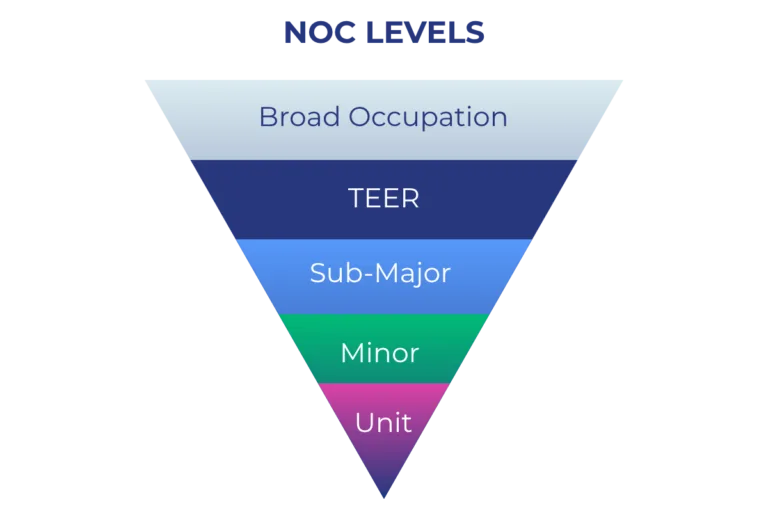
Each level adds precision. For example, a CDP may use a broad or major group to help a client explore widely or consider options across a sector, while a unit group is more useful when a client has a precise job target for examining job duties, wages, or training requirements for a specific role.
Most practitioners do not need to work at all five levels in daily practice. However, understanding that this hierarchy exists helps explain why the same occupation can appear in multiple tools and why labour market data sometimes looks more aggregated or more specific, depending on the source.
For learners who want to explore the full structure in detail, the Government of Canada provides an interactive, step-by-step tutorial you can access here. This tutorial is especially helpful for those interested in labour market analysis, policy work, research, or advanced use of formal LMI.
Breaking Down a 5-Digit NOC Code: An Example
The NOC 2021 uses a five-digit coding system to specify occupations. Let’s take a closer look at how the 5-digit NOC 2021 code works using a familiar role: NOC 41321 – Career development practitioners and career counsellors (except education).
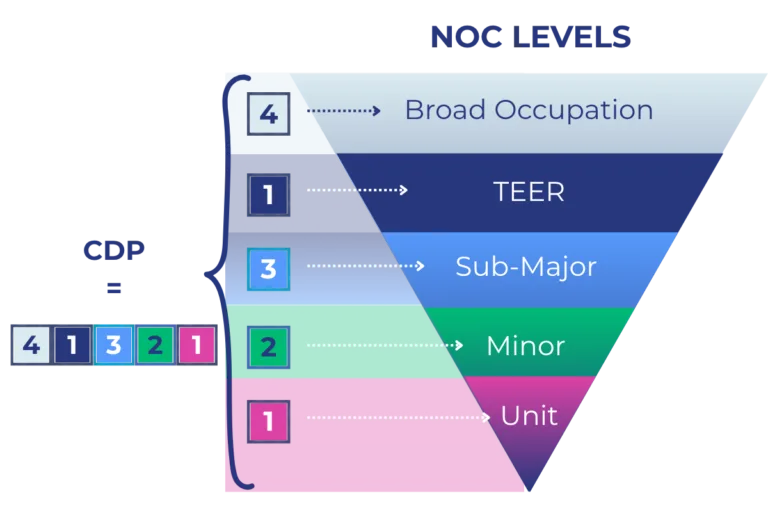
Each digit in this code tells us something different about how the occupation is classified.
First digit – Broad Occupational Category
The first digit places the occupation within a broad area of work, with the 10 broad occupation categories (the first digit of the NOC code) being:
| 0 – Legislative and senior management occupations |
| 1 – Business, finance and administration occupations |
| 2 – Natural and applied sciences and related occupations |
| 3 – Health occupations |
| 4 – Occupations in education, law and social, community and government services |
| 5 – Occupations in art, culture, recreation and sport |
| 6 – Sales and service occupations |
| 7 – Trades, transport and equipment operators and related occupations |
| 8 – Natural resources, agriculture and related production occupations |
| 9 – Occupations in manufacturing and utilities |

In the case of CDPs (NOC 41321, the number 4 represents occupations related to education, law and social, community, and government services.
This helps situate the role within a larger family of helping and service-oriented professions.
Second digit – TEER and Major Group
The second digit in the NOC code is the TEER number. The TEER number describes the typical level of training, education, experience, and responsibility (TEER) associated with an occupation. The TEER categories range from TEER 0 to TEER 5:
| TEER 0 – Management roles |
| TEER 1 – Occupations usually requiring a university degree |
| TEER 2 – Occupations typically requiring a college diploma, apprenticeship training of two or more years, or significant supervisory experience |
| TEER 3 – Occupations typically requiring a college diploma, apprenticeship training of less than two years, or more than six months of on-the-job training |
| TEER 4 – Occupations typically requiring secondary school and short-term training |
| TEER 5 – Occupations with short work demonstration and little formal training |

TEER categories are descriptive, not prescriptive. They describe what is typical, not what every employer requires. This distinction is important when working with clients who may have non-linear pathways or equivalent experience.
For CDPs, the number 1 represents occupations usually requiring a university degree.
Combining the first two digits results in major groups. Within the occupations in education, law and social, community and government services – where CDPs are situated – the major groups are:
| 40 – Managers in public administration, in education and social and community services and in public protection services |
| 41 – Professional occupations in law, education, social, community and government services |
| 42 – Front-line public protection services and paraprofessional occupations in legal, social, community, education services |
| 43 – Assisting occupations in education and in legal and public protection |
| 44 – Care providers and public protection support occupations |
| 45 – Student monitors, crossing guards and related occupations |
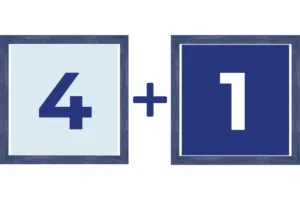
The number 41 places CDPs within professional occupations in law, education, social, community and government services, typically requiring a university degree.
Third digit – Sub-Major Group
The third digit narrows the occupation further by identifying its sub-major group. Sub-major groups cluster occupations that share similar professional functions within a broader sector.

For CDPs (NOC 41321), the third digit is 3. This places the role within the sub-major group of professional occupations in social and community services. At this level, the classification distinguishes community- and client-focused professional roles from other professional work within education, law, or government services.
This grouping helps situate career development work alongside other professional roles that support individuals and communities through counselling, guidance, and social services.
Fourth digit – Minor Group
The fourth digit identifies the minor group which brings together occupations that perform closely related functions or work within similar service contexts. At this level, occupations are grouped based on similarities in service delivery, client interaction, and the kinds of employability needs they address.

In NOC 41321, the fourth digit is 2, indicating a minor group called educational and employment counsellors, professionals whose work focuses on career development, employment services, and related professional support roles.
This fourth level is particularly useful for CDPs when helping clients explore adjacent roles or career pathways within the same functional area, such as moving between different types of counselling, employment services, or workforce development roles.
Fifth digit – Unit Group
The fourth digit identifies the minor group which brings together occupations that perform closely related functions or work within similar service contexts. At this level, occupations are grouped based on similarities in service delivery, client interaction, and the kinds of employability needs they address.

In this example, 41321 refers specifically to career development practitioners and career counsellors (except education). This is the level most frequently used in formal LMI tools such as Job Bank, the Career Handbook, and LMIC dashboards.
At the unit group level, CDPs and clients can find detailed information about:
- Typical job duties
- Common employment requirements
- Example job titles used by employers
- Links to related occupations and labour market data
Cautionary Note
The NOC can be extremely useful, but it does not always reflect the evolving nature of roles in the labour market. Our own CDP code (41321) is a great example of this. Our code lumps CDPs together with career counsellors. While there are overlapping competencies between these occupations, they are not equivalent in terms of requirements or scope of practice. Whenever using the NOC (or any LMI), always consider its credibility, reliability, and relevance...and check it against other formal or informal sources.
Practice Activity
- Go to the NOC website.
- Enter a job title for an occupation of your choosing and explore the search results.
- Notice the 5-digit code and TEER category shown for the unit group.
- Click on the job title in the search result to see the sections you would use most often in practice (main duties, employment requirements, example titles, etc.).
