
3: Employability Dimensions
Information, including LMI, becomes meaningful when tied to a personal need. We use the Employability Dimensions as a framework for assessing client employability needs and for the development and implementation of many employability interventions.
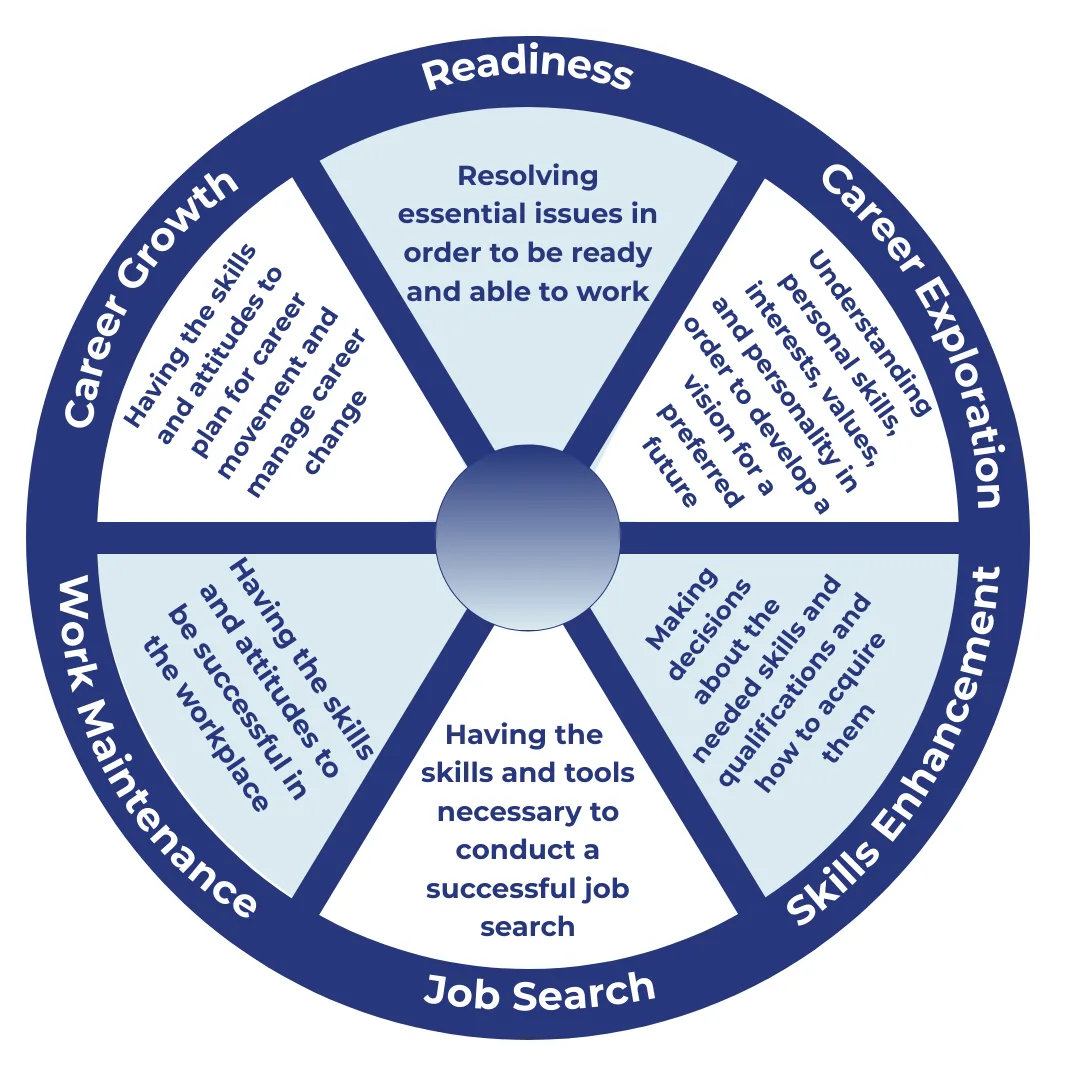
Click the image to zoom in
The six Employability Dimensions offer a shared way to understand the full range of factors that influence a person’s ability to find and maintain work. Originally developed by Human Resources Development Canada (HRDC) and later expanded by noted career development expert Dr. Norm Amundson, they help career development practitioners recognize both client strengths and areas needing support. Whether familiar or new, the framework provides a comprehensive lens for guiding effective, client‑centred interventions.
Explore the six Employability Dimensions below.
Readiness
This dimension is focused on foundational issues such that, if left unresolved, often get in the way of employability.
Examples of client needs
- Adequate transportation
- Adequate childcare
- Stable and safe housing
- Supportive relationships
- Support(s) for physical health challenges
- Support(s) for mental health challenges
- Support(s) for use of addictive substance
- Ability to take responsibility for their own choices and behaviours
- Strategies to stay motivated
Career Exploration
This dimension is focused on a person’s degree of clarity about their career direction.
Examples of client needs
- Knowledge of interests, values, strengths/skills
- Knowledge of learning/employment options that connect to their interests, values and strengths/skills
- Knowledge of entry requirements, employment rates and conditions in their preferred community for desired employment
- Knowledge of issues that could affect hiring for their desired employment (physical requirements, criminal record restrictions, travel requirements, etc.)
- Evaluation of learning/employment options based on research and self-knowledge
- Achievable learning/employment goals
- Ability to follow through on agreed upon action plan steps
Skills Enhancement
Examples of client needs
- Determining skill requirements for a chosen occupation
- Understanding existing skills and gaps
- Information on education or training program(s)
- Application support for chosen education/training program(s)
- Strategies to address anticipated challenges transitioning to school or training program(s)
Job Search
Examples of client needs
- Achievable employment goal or realistic business plan
- Understanding of workplace norms and expectations in preferred area of employment
- Information on the skills requirements for preferred area of employment
- Information on potential employers/opportunities
- Work search/marketing tools (resume, portfolio, social media profiles, references, website etc.)
- Effective interviewing and self-marketing skills
- Access to online resources effectively in work search/business development
- Strategies, supports and networks to stay motivated in work search
Work Maintenance
This dimension’s focus is on helping individuals keep the work they have found.
Examples of client needs
- Knowing the responsibilities and expectations related to their current employment
- Demonstrating the skills and attitudes needed in their current employment
- Accepting and acting on corrective feedback
- Seeking help or supervision when needed
Career Growth
This dimension’s focus is on growing in one’s field or career.
Examples of client needs
- Awareness and access to new learning and up-skilling
- Ways to deal effectively with stress
- Career management skills (e.g., ability to understand yourself, identify your existing skills, explore and set realistic life, learning and work goals, action plan)
- Strategies to support career/work change
- Goals to help them reach their preferred future
- Ability to adapt when work circumstances change
- Understanding how labour market changes (e.g. technological developments) influence changes in knowledge, skill and attitudes required for work success
